

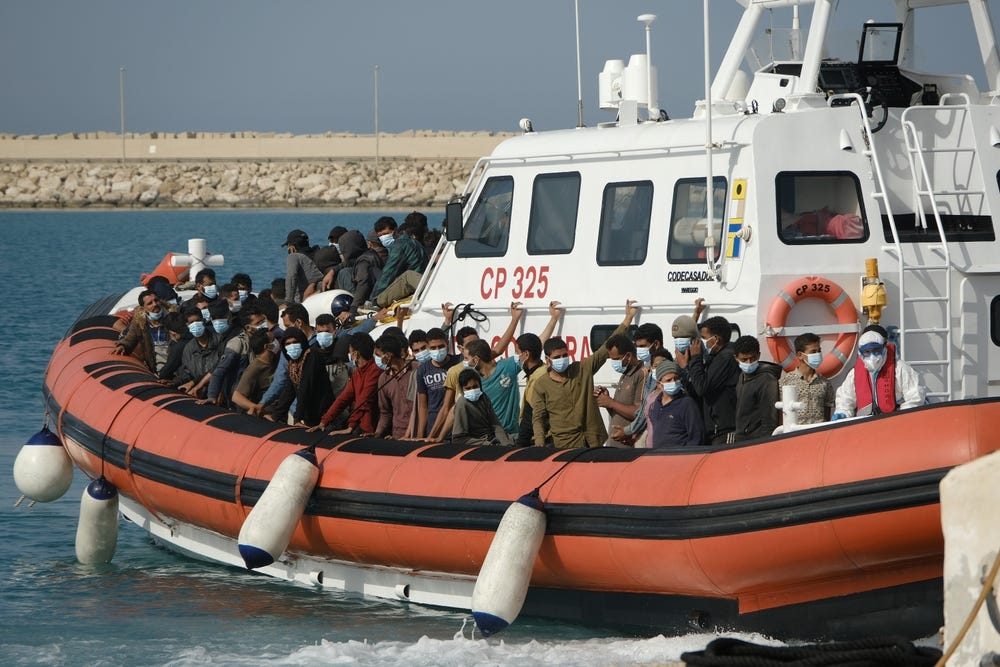
The European Court of Human Rights (ECHR) has unanimously condemned Italy for depriving an unaccompanied 15-year-old foreign minor of his liberty. The judgment, filed in Strasbourg on September 3, 2026, in the case of B.C. v. Italy, finds a violation of the right to liberty and security under Article 5 of the European Convention on Human Rights and orders the State to pay the boy €4,000 in non-pecuniary damages within three months. The applicant, an Ivorian national born in 2008, was held from October 6 to December 22, 2023, at the CARA (Reception Centre for Asylum Seekers) in Restinco, in the province of Brindisi, without a clear and accessible legal basis justifying his confinement, without a reasoned order authorizing it, and without any possibility of challenging it before a court. The Italian Government argued that there had been no detention and that his stay lasted only as long as necessary to identify suitable accommodation; the Court, however, characterized those two and a half months as an “arbitrary deprivation of liberty.” His transfer to a facility for minors occurred on December 22, two days after an urgent interim measure was requested from the Court.
As set out in the judgment, the boy arrived in Italy on August 3, 2023, and was placed in an extraordinary reception centre in Carovigno, also in Brindisi province, where he declared he was a minor and showed a photograph of his birth certificate. The age assessment concluded on October 2, confirming he was underage, and four days later he was transferred to Restinco, a facility originally designed for adults and later repurposed to host only minors due to rising arrivals. During his stay the centre housed 88 boys, and the applicant’s provisional guardian was also the facility’s director—a clear conflict of interest with the role he was supposed to perform. Decisive for the Court’s finding was the applicant’s inability to leave the centre. The ECHR judges relied in part on findings similar to those described by Italy’s Ombudsperson for Children and Adolescents, who, in a parliamentary hearing, had described very high walls, an iron gate, soldiers posted outside, and boys convinced they were in prison.
Over the years, the Restinco centre has repeatedly drawn scrutiny from migrant-rights associations. In 2016, ASGI (Association for Juridical Studies on Immigration) stressed that the site “does not appear in any way suitable for the reception, even temporary, of minors, and indeed the law expressly prohibits it,” precisely because the structure, originally conceived for adults, did not meet “the protection needs of a vulnerable category such as minors.” Later, when in 2023 the association requested access to the facility to verify conditions, that request was denied. The applicant’s lawyers, cited by ASGI, said the ruling represents “yet another decision confirming the structural lack of care by Italy for the condition of unaccompanied foreign minors,” adding that “the government and parliament will necessarily have to take this into account in implementing the new Pact on Migration and Asylum and the upcoming Return Regulation, which, incredibly, does not exclude the possibility of detaining and returning unaccompanied minors.”
This is not the first time a European body has condemned Italy’s management of migrants. In July 2022, in the case of Darboe and Camara, Strasbourg already condemned Italy for placing a minor in an adult centre and for an age assessment carried out without safeguards. That was followed by the M.A. judgment of August 2023, the ruling on A.T. and others in November 2023 concerning the Taranto hotspot, a decision on the Crotone centre in December of the same year, and, on April 9, 2026, the condemnation in the H.D. case for detaining an unaccompanied minor for more than five months at the CARA in Isola di Capo Rizzuto. The problem of a missing legal basis goes back even further, to the 2016 Khlaifia judgment on Lampedusa and the subsequent J.A. ruling of March 2023, both cited in the text filed this month. On the non-judicial front, in December 2024 the European Committee for the Prevention of Torture defined Italy’s centres for return detention as overall “unsuitable,” while on August 1, 2025, the Court of Justice of the European Union held that a country cannot be designated as safe if it does not protect its entire population, undermining the framework behind the centres built in Albania.
[L’Indipendente, September 14, 2026, Alberto Biondi]