

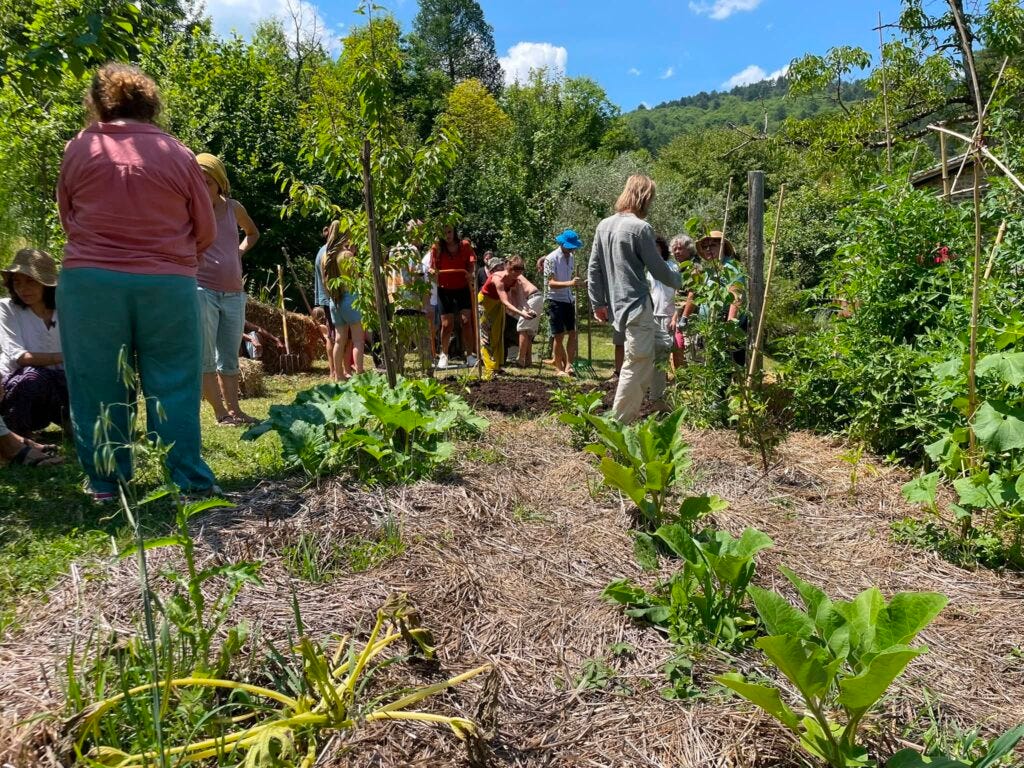
The Natural Agriculture Network (RAN) has launched a project to connect farmers who select, preserve, and exchange seeds free from patents and genetic manipulation. The initiative comes in response to the European regulation on new genomic techniques, definitively approved by the European Parliament last June, which classifies a large share of new genetically modified organisms alongside conventional varieties. The first practical event will take place from August 7 to 9 in the Marche region, at Natural Farm Shizen in Pergola, in the province of Pesaro and Urbino.
The project, which RAN has named the “Distributed Seed House,” is described by the association as “a broad group of farmers and growers who safeguard, reproduce, exchange, and share natural seeds free from patents and genetic manipulation.” The idea is to bring them together in a “Network of Cultivated Biodiversity Guardians.” The announcement, shared on the association’s social media channels, received thousands of reactions and shares within a few hours, prompting the association to move immediately from words to action. During the August weekend, Antonio Lo Fiego, technical director of Arcoiris Sementi Bio, will lead “Seeds of the Future,” a zero-waste workshop based on the gift economy and dedicated to the selection, harvesting, and preservation of vegetable seeds. Kutluhan Özdemir and Ezio Maisto, who founded RAN in 2021, will also take part. They will open the doors of the natural farm and explain the role of seeds in the “do-nothing” agriculture theorized by Japanese botanist Masanobu Fukuoka. For the organizers, the project “cannot grow out of a warehouse full of seeds, but from people who learn to safeguard, reproduce, and pass them on.”
The contested European regulation profoundly alters the system for regulating genetically modified plants. Unlike older GMOs, which are based on transgenesis—the insertion into an organism’s genome of a gene from a different species—the new techniques include cisgenesis, which transfers genes between organisms of the same species, and genome editing, which modifies or silences DNA that is already present. Category 1 varieties, which account for approximately 94 percent of the new GMOs currently under study, will be treated like conventional varieties and exempted from consumer labeling, supply-chain traceability, and risk assessments. The only remaining requirement will be for the developers of the technology to submit patent data to a public database overseen by a group of experts. Member states will also be barred from prohibiting the cultivation of these plants on their own territory. The text was approved by the Council of the European Union in April, with 18 countries—including Italy—voting in favor. Croatia, Hungary, Austria, Romania, Slovenia, and Slovakia voted against it, while Belgium, Bulgaria, and Germany abstained. The European Parliament gave its final approval last month after rejecting all of the proposed amendments.
Supporters of the reform, beginning with its rapporteur, Jessica Polfjärd, present it as a response to climate adaptation and the need to reduce dependence on pesticides. Copa and Cogeca, the main European agricultural organizations, welcomed the vote. Corporate Europe and La Via Campesina took the opposite view, arguing that the agreement “is based on empty promises about the supposed sustainability of NGT crops, which is not supported by any scientific evidence or by their availability on the market,” with the real objective of “imposing the patent model in Europe” on seeds, including traditional and farmers’ varieties.
Similar criticism has come from Navdanya International, the Indian organization founded by Vandana Shiva. In the “Seeds of Resistance” report, published at the end of 2025, the association denounced unforeseen genetic alterations, chromosomal instability, transgenic contamination, and new forms of corporate control made possible by the removal of risk assessments, labeling, and traceability requirements.
The issue touches on a broader problem: according to Simone Vezzani, a professor of international law at the University of Perugia, the food sovereignty of many countries is being placed under pressure by land grabbing, through which investment funds and multinational corporations acquire agricultural land for export, taking it away from local communities. It is also being threatened by the growing concentration of the seed and agrochemical markets in the hands of a few giants in the chemical industry. The professor describes this as a genuine “enclosure”—a “fence” that traps the commons—created by extending intellectual property rights to living organisms. The issue is particularly crucial today, given that while global agricultural production would be sufficient to feed the entire global population, 700 million people living in rural areas are denied the right to food. The issue is not merely economic; it involves a profound legal transformation: the privatization of the resources from which we obtain the food we need.
Both major international networks and Italian organizations are responding to this pressure, albeit through different approaches. One is the Rural Seed Network, founded in 2007 and now made up of approximately 40 organizations, with a community seed bank in Florence. The other is RAN, which practices agriculture without plowing, chemical fertilizers, herbicides, or pruning, leaving the natural processes of the soil to perform the work that human intervention carries out elsewhere.
[L’Indipendente, July 27, 2026, Mario Catania]